What to Actually Demand from Your Affiliate Marketing Agency
Every affiliate agency will tell you they drive growth. Fewer will tell you what that growth costs, how it happened, or whether it’s sustainable without them. If your monthly recap is a summary of last month’s numbers, you don’t have a strategy; you have a subscription.
The affiliate landscape looks nothing like it did five years ago. Publisher types have multiplied, channels are expected to interact with each other, and AI search platforms are reshaping how customers discover products. Most agencies haven’t caught up. Here is what to look for in an affiliate agency now, and what to demand from the one you already have.
How to Measure Affiliate Marketing ROI: Growth-to-Cost Ratio vs. Reach
The clearest measure of affiliate marketing ROI is your growth-to-cost ratio: the revenue your program returns for every dollar spent on commissions, publisher fees, and management. Most agencies can show you revenue. Far fewer can show you this ratio, and fewer still can explain what is driving it.
That ratio only means something when it is measured against the right standard. Reach is easy to buy and easy to report. A completed purchase, a signup, an actual conversion: those are the only numbers that pay you back. A program that can’t articulate its growth-to-cost ratio against real conversions is being maintained, not managed. Ask how yours compares to the rest of your marketing mix. If nobody can answer, your affiliate budget is being spent, not allocated.
The answer usually comes down to the resources an agency can actually reach.
- Do they have a vetted pool of influencers?
- Do they have relationships with mass media partners?
- Can they name the publishers driving your conversions, not just your clicks?
The goal is quality of content, not volume of placements. Content that reaches a trusting audience converts, so your agency needs relationships with publishers producing that kind of intentional work across every channel.
Affiliate performance is not defined by revenue or reach alone. The case for an affiliate marketing agency rests on an expansive publisher network and a rising conversion rate: more profit for your brand, not more line items in a report.
Why Affiliate, Influencer, Paid Media, and AI Search Should Run as One Integrated Marketing Strategy
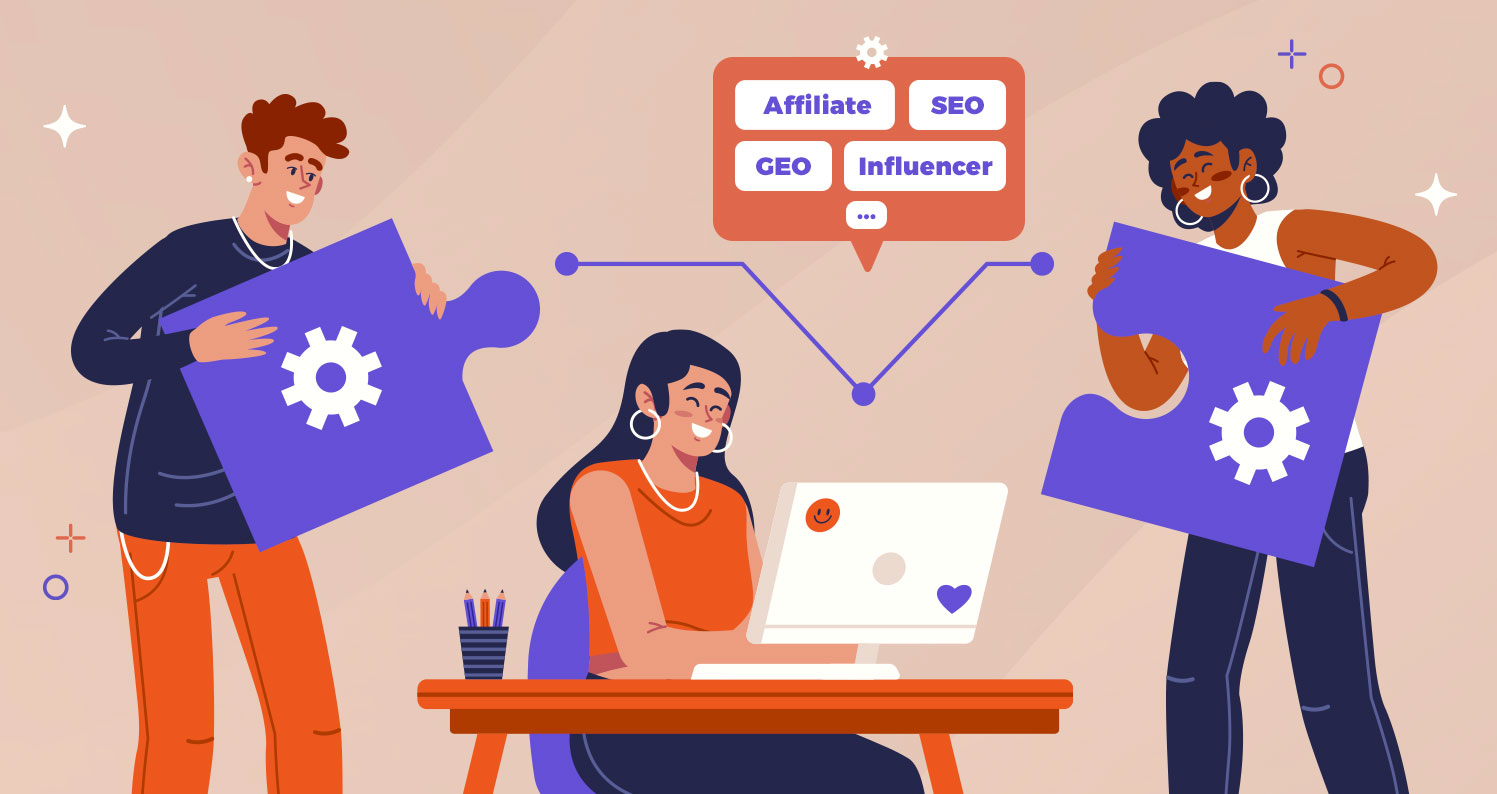
If your affiliate, influencer, paid media, and search teams don’t talk to each other, you don’t have a strategy.
The best-performing programs treat every channel as an input into the others. A creator’s top-performing content should get repurposed into paid ads, product pages, and email. The publishers driving your strongest affiliate revenue should inform who your influencer team recruits next. The language proven to convert in paid search should shape the content built for AI visibility, and vice versa.
None of that happens when each channel sits with a different team, a different report, and a different point of contact. Ask your agency who is responsible for making sure your affiliate, influencer, paid media, and AI search strategies build off each other instead of just coexisting. If the answer is nobody, or “that’s a different department,” you’re paying for four separate bets instead of one connected strategy built around your business.
Why Affiliate Program Technology and Real R&D Beat Spreadsheets
Affiliate program technology is what separates a program that compounds from one that resets every time someone leaves. Most programs still run on a mix of network dashboards, exported spreadsheets, email threads, and whatever one account manager happens to remember. When that person leaves, so does the institutional knowledge behind every decision that shaped your program. That is an infrastructure problem, and it is one the industry has largely accepted rather than solved.
At the same time, most agencies have no real answer for what is happening in AI search. Traditional SEO still matters, but it is no longer the whole picture. A meaningful share of product research now happens inside ChatGPT, Gemini, Claude, and Perplexity, and few agencies have built anything that tells you whether your brand shows up there.
GEO, or generative engine optimization, is the practice of building content that AI platforms can find, trust, and cite in their answers. GEO for affiliate marketing is not the same skill set as ranking a landing page on Google, and treating the two as interchangeable is how brands end up invisible in the exact moment a customer is choosing what to buy.
Both gaps trace back to the same root cause. An agency that isn’t investing in its own research and development is reselling the tools everyone else can buy, watching the landscape shift instead of preparing for it. So ask a direct question: what have you built in the last year that I couldn’t get off the shelf? The answer tells you whether you are hiring a strategy or a subscription.
How Gen3 Marketing Meets Its Own Affiliate Agency Standard
We didn’t write this list from the outside looking in. We wrote it because it’s the standard we hold ourselves to.
Gen3 Marketing is a full-service digital marketing agency based in Blue Bell, PA, and the largest independent affiliate marketing agency in the world. Our clients see an average 10:1 return on ad spend across more than $2 billion in annual revenue we help drive, measured against real conversions rather than impressions.
We also don’t run affiliate, influencer marketing, paid media, and GEO as separate business lines pointed at the same client. They are one strategy, built by teams working from the same data, so a creator’s best-performing content gets repurposed into paid campaigns and product pages, and the publishers driving revenue shape where our AI search work focuses next.
That connected approach only works because we built the infrastructure behind it. Gen3 Marketing’s amplifi unifies fragmented affiliate data, workflows, and AI-driven intelligence into a single operating system, powered by more than 20 years of real performance data, so opportunities get acted on instead of buried in a spreadsheet. Our proprietary benchmarking engine turns program trends, publisher efficiency, and commission strategy into a clear view of where your program stands against the market. Our propietarey AI Visibility tool, powered by amplifi, tracks how your brand appears across LLMs, showing exactly where you are surfaced, overlooked, or outperformed across the consumer decision journey instead of leaving AI search as a blind spot.
Questions CMOs Ask Before Switching Affiliate Agencies
What should I look for in an affiliate agency?
Look for three things: a growth-to-cost ratio the agency can explain and tie to real conversions, one connected strategy across affiliate, influencer, paid media, and AI search, and proprietary affiliate program technology the agency built rather than licensed. An agency that can only produce a monthly recap is maintaining your program, not managing it.
How do I measure affiliate marketing ROI?
Measure affiliate marketing ROI as a growth-to-cost ratio: total program revenue divided by total program cost, including commissions, publisher fees, and management. Compare that ratio to the rest of your marketing mix, and confirm it is calculated against completed conversions rather than clicks, impressions, or reach.
What is GEO for affiliate marketing?
GEO for affiliate marketing is the practice of making your brand and your publishers’ content findable and citation-worthy inside AI search platforms like ChatGPT, Gemini, and Perplexity. It matters because a growing share of product research now starts in an AI answer rather than a search results page.
How do I know if my affiliate agency is actually managing my program?
A managed program has a named owner for cross-channel strategy, a documented growth-to-cost ratio, and a clear answer for how the brand appears in AI search. A maintained program has a monthly recap, four separate reports, and institutional knowledge that lives in one person’s inbox.
What This Means for Your Brand
If your current agency can answer every question above with specifics instead of a recap, you have a good partner. If it is managing your channels with yesterday’s toolkit and no visibility into how AI search sees your brand, let’s talk about what a connected strategy looks like when every marketing dollar is measured against real conversions.

Alongside Andy Cantos, Mike Tabasso is the co-founder and CEO of Gen3 Marketing. With decades of experience, Mike specializes in driving growth at the intersection of digital marketing and business transformation. He considers building and scaling the largest standalone affiliate and partner marketing agency in the world the highlight of his career. Mike is passionate about leveraging digital channels—including affiliate, influencer, paid, search, and SEO—to unlock new revenue streams and deepen customer engagement.