
Affiliate Marketing Strategy: Why It Deserves a Seat at the Strategic Table (And the Data to Prove It)

A disconnect sits at the center of most digital media plans, and it costs brands revenue every quarter.
Affiliate marketing is rated effective by 92% of companies. It receives 11% of the average performance marketing budget. For a channel delivering measurable, pay-for-performance results at scale, that is not a rounding error. It is a strategic blind spot. Most brands do not have an affiliate marketing strategy so much as an affiliate line item.
Affiliate marketing is a pay-for-performance channel in which brands compensate third-party publishers, from content sites and review platforms to creators, cashback apps, and loyalty programs, only for the sales and customers those partners generate.
Gen3 Marketing set out to quantify that disconnect. Our original research report, High Performance and High Demand, surveyed more than 2,000 consumers and 250 senior digital marketers, plus qualitative interviews with 20 industry thought leaders. It is the first multi-perspective study to place actual consumer purchase behavior beside how brand marketers prioritize the affiliate channel.
Where do consumers shop online? Across affiliate publishers at every stage of the purchase journey.
Consumers use affiliate publishers constantly, at every stage of the purchase journey. Every one of the 2,000+ consumers surveyed reported visiting affiliate publishers during at least one phase, from inspiration through purchase. No exceptions.
Cost consciousness drives the behavior. Some 86% of shoppers say they are more cost-conscious than a year ago, 76% are using more online deal websites, and 75% will try a new brand when an online deal is involved. Engagement also raises basket size: 78% add more to their cart.
This is the codependent commerce journey: consumers want brand promotions, brands want consumer sales, and affiliate partnerships are the connective tissue between them. It is a retention play as well. Shoppers report greater loyalty to brands that offer deals.
Where do shoppers start their purchase journey? More on mass media and magazines than search or Amazon.
Inspiration now begins in editorial media. When consumers look for inspiration before a purchase, 37% start on popular magazines and mass media sites such as Hearst properties, InStyle, Men’s Health, and Us Weekly. Search engines account for 24%. Retail marketplaces account for 21%.
Much of that editorial commerce content is affiliate. Shoppable articles, product roundups, and “best of” guides in major publications have absorbed a large share of what used to be earned PR, and they drive measurable purchase behavior. It is the same order of shift as 2015, when consumers moved product searches to Amazon ahead of Google and brands rebuilt marketplace strategy in response.
Every affiliate publisher subcategory plays a role here, from gift registries and coupon sites to member benefit platforms. An affiliate publisher strategy built only around conversion-stage partners hands the inspiration phase to competitors.
Is affiliate marketing only a bottom-of-the-funnel channel? Here’s what the data shows.
No, one of the most persistent misconceptions about affiliate marketing is that it belongs at the bottom of the funnel. Affiliate publishers appear at every funnel stage, and no publisher category is confined to one.
In the research phase, consumers turn to search results, customer reviews, and expert reviews, many of them affiliate placements outranking brand sites. In consideration, cashback platforms, loyalty programs, price comparison tools, and gift registries drive the final decision. Every one is an affiliate category. Higher-ticket purchases pull in more of them: above $500, more than half of shoppers report heavy research, which means more touch points and more opportunities for affiliate to shape the outcome.
The transaction usually closes on a brand site or a marketplace. Affiliate drove the shopper there. Full-funnel affiliate marketing means building around the shopper’s journey rather than around a publisher type, placing the right content, deal, or comparison tool at each stage.
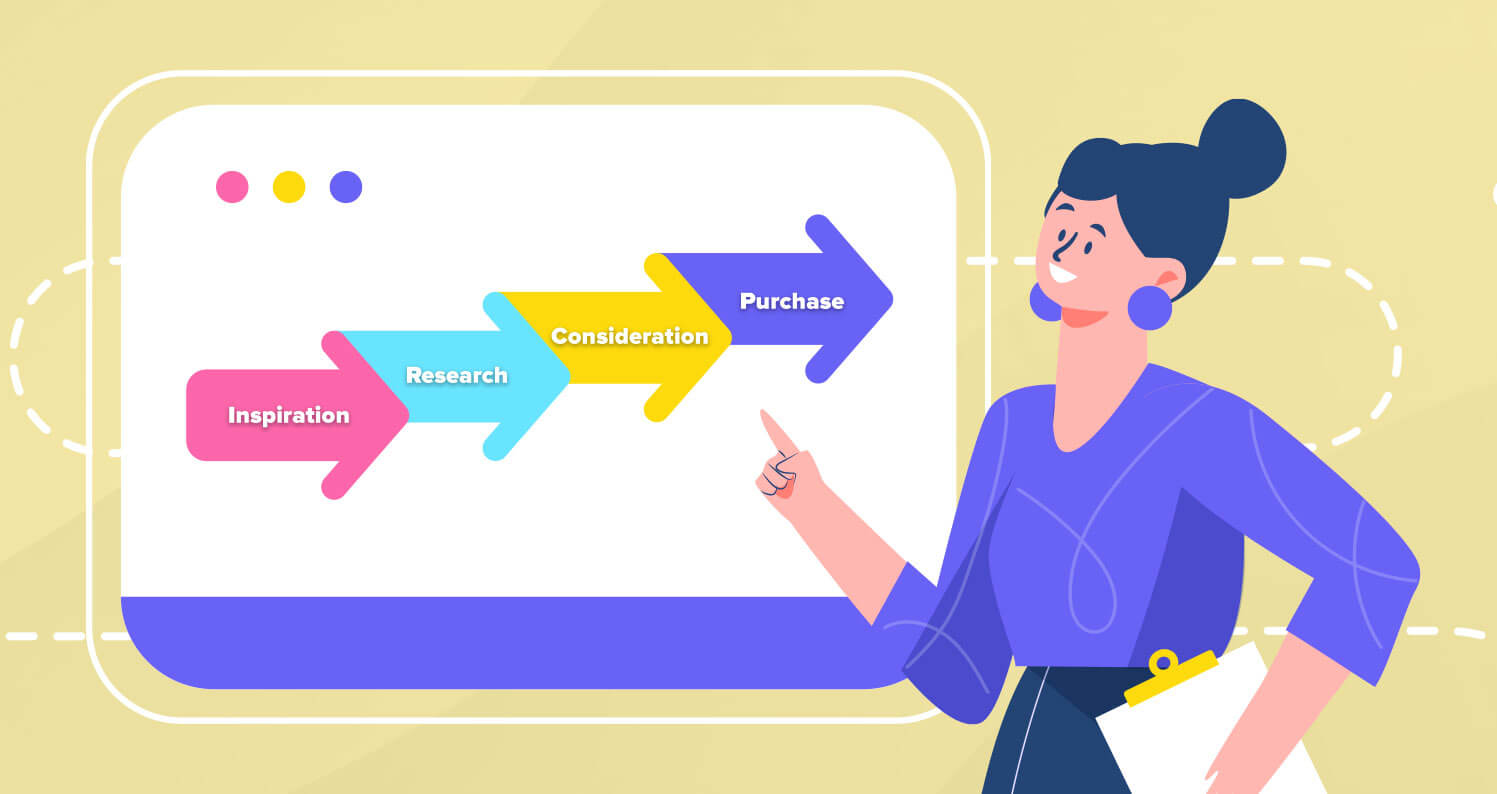
Consumers visit affiliate publishers across every stage of their purchase journey, from initial inspiration to final conversion.
How trustworthy are influencers in affiliate marketing? Only 28% of consumers say very trustworthy.
Reach is not the constraint. Trust is. Only 28% of consumers consider influencers very trustworthy, even though 25% view influencer content daily and 60% say influencers introduce them to new products and brands.
Influencer affiliate marketing is shifting from an awareness play to a sales channel as more creators add affiliate links to sponsored content. That turns credibility into a performance variable rather than a brand-safety checkbox, so partner selection should weight trustworthiness alongside reach and engagement. It also widens the gap between the influence a creator exerts and the conversions a tracking link records, a tension we cover in the influence versus tracking paradox reshaping affiliate measurement in 2026.
Why don’t brands invest more in affiliate marketing? The barriers are outdated… and fixable.
The barriers are internal, not performance-related. Negative perceptions rooted in practices that disappeared more than a decade ago persist among 60% of brand marketers. Another 64% lack senior executive buy-in, 63% treat affiliate as separate from other marketing activity, and 78% run it as a tactical rather than a strategic function. Only 13% have achieved genuine omnichannel marketing integration.
None of that reflects what marketers say they value. Strong ROAS is a priority for 82% of them, 75% prefer pay-for-performance models, and 62% are shifting budget toward more measurable channels. Affiliate meets all three. Brands rate affiliate channel effectiveness at 92%, then set affiliate budget allocation at 11%.
The fix is not a better pitch deck. It is a business case in the language budget holders already use: ROAS, cost per acquisition, measurability, and risk-adjusted performance.
What should brands do to maximize affiliate marketing ROI? Start with strategy, not tactics.
Maximizing affiliate marketing ROI depends on where affiliate sits in the planning process. Four moves close the gap:
- Reframe affiliate as the channel of channels. It is not one media line competing with the others. Integrated properly, it amplifies every media investment you are already making.
- Get it into strategic planning from the start. Added after budgets are set, it is capped before launch. That is the distance between the 78% running affiliate tactically and the 13% who have integrated it.
- Treat partners like audiences, not placements. The strongest affiliate programs are built around partners’ ability to reach high-value consumer segments at scale. Understanding who each partner influences and where they fit in the customer journey unlocks more effective investment decisions.
- Prove it with full-funnel activations. Product launches, strategic publisher partnerships, customer acquisition campaigns, inventory offloading initiatives, and cross-channel ROAS comparisons make the case concrete.
As attribution technology matures, affiliate teams will be pulled into holistic budget planning whether or not they ask to be. Brands that build the internal case now will set the terms.
Consumers are already inside the affiliate ecosystem. The question is not whether they use these channels. They do, at every stage of every purchase. The question is whether your brand is there when it counts.
Frequently asked questions about affiliate marketing strategy
What percentage of media budget should go to affiliate marketing?
Brands currently allocate 11% of the average performance marketing budget to affiliate while rating the channel 92% effective. There is no universal benchmark, but that gap indicates most programs are funded below their measured performance. The practical starting point is comparing affiliate ROAS and CPA against your other channels, then reallocating toward whichever performs better.
Is affiliate marketing top of funnel or bottom of funnel?
Both. Gen3’s research found affiliate publishers active across inspiration, research, consideration, and purchase, with 37% of shoppers beginning their journey on mass media and magazine sites, ahead of search engines at 24%. No publisher category is confined to a single funnel stage.
How do you measure affiliate marketing ROI?
Affiliate marketing ROI is measured with the same metrics as any other performance channel: ROAS, cost per acquisition, and incremental revenue contribution. Because the model is pay-for-performance, cost is only incurred on a completed action, which makes affiliate one of the lowest-risk channels to measure and one of the easiest to defend in a budget review.
How do you get executive buy-in for affiliate marketing?
Lack of senior executive buy-in affects 64% of marketers. Close it by presenting affiliate in financial rather than channel terms: ROAS comparisons against other media, the reduced risk of paying only for performance, and affiliate’s role in amplifying existing media investment rather than competing with it for budget.
For brands ready to build a full-funnel affiliate marketing strategy that integrates with broader media investment and drives measurable growth, Gen3’s affiliate marketing services are built for exactly that.
Download the High Performance and High Demand research report for the complete data set across 2,000+ consumers, 250+ senior marketers, and 20 industry thought leaders, and the foundation for making the case inside your own organization.

Experienced and Passionate Affiliate Marketer and Team Lead.